
Soft power
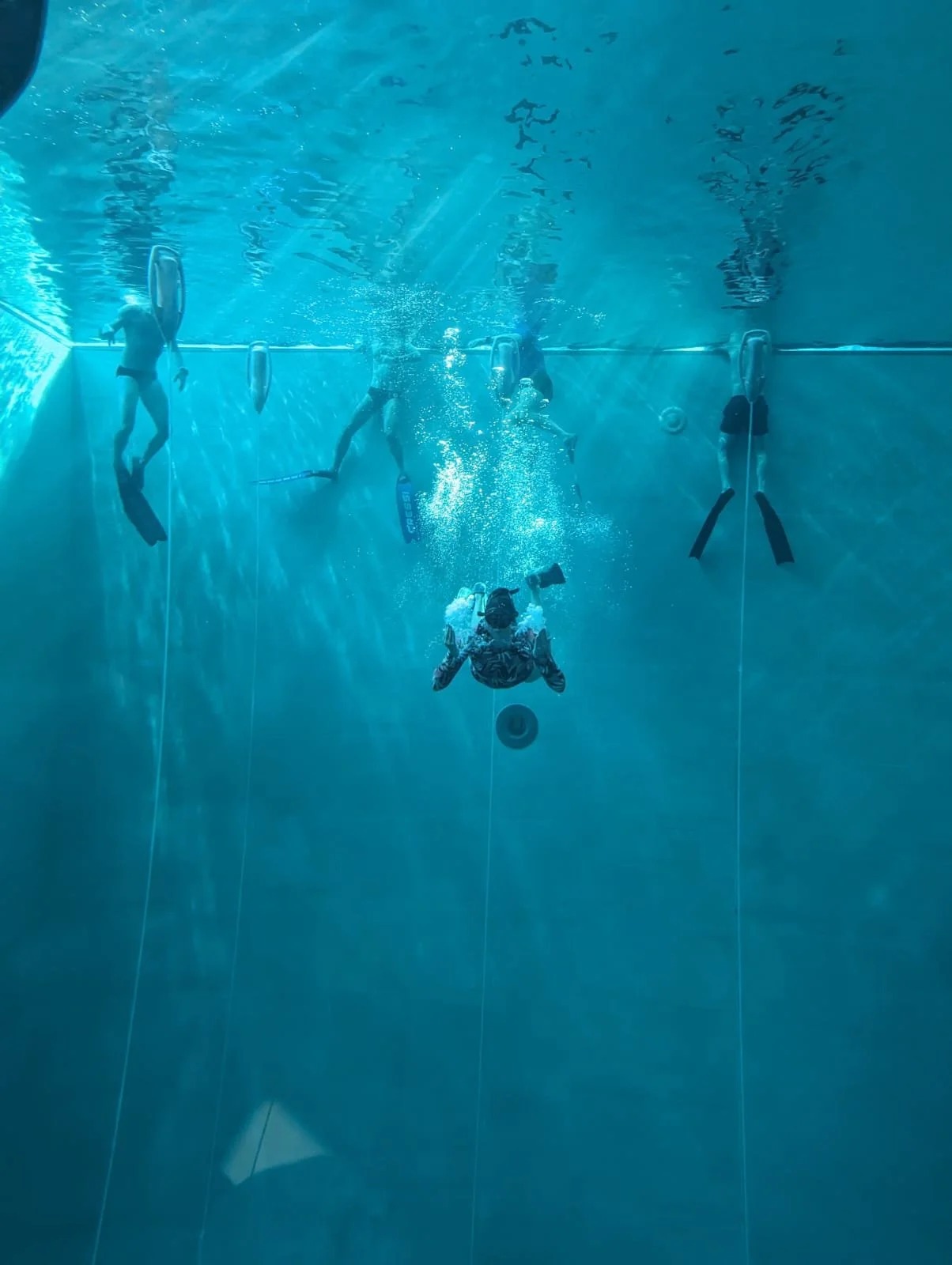
“A kiss from the depth” - Y40, Italy
A couple of years ago I went for the first time to a freediving school to train. I was already exposed to depth training, but it was mostly for fun, with experienced freedivers around me. Our training in that freediving school was quite intense, and it included time in the water, as everyone would expect, but it also included a lot of training outside the water. Breathing exercises, stretching, and a bunch of other things.
One day we were doing a breathing exercise guided by one of the instructors that included diaphragmatic stretching. I was pulling and pulling and pulling to get that stretch as deep as it could go, determined to succeed. I had no clue at that point that gentleness would get the diaphragm to stretch a bit more, but this is why you have instructors. In a magic moment I will never forget, the instructor said, “Soft power.”
I was confused. What am I supposed to do? Power through this or be soft?
The concept of soft power was so confusing for me. How can you have softness and power at the same time? In my head those two were completely different things, not even remotely related. I laughed and continued stretching that diaphragm, a muscle that the majority of us never even pay attention to, and decided to think about it later.
Later came and as usual, I started philosophising it. It reminded me a little bit of what my breathwork teacher was telling me about the hidden strength that softness has, but I found it very challenging to embody it in that moment. If there was one thing I knew in life, it was how to push. And the more I pushed, the stronger I felt. Soft power, ha. Alright.
Years passed I did the work and I thought I knew what softness is. Recently, I went back to the same school, determined to go deeeeeep. Little did I know that with pushing I would get nowhere else but the surface. Because what I learned is that the water doesn’t reward force, at least not in the long run, but it rewards surrender, patience, and presence. And those three require quite a bit of power and strength to be sustained and achieved.
Tension is expensive. To the nervous system. To the body. To life in general. And as much as I have embodied over the years finding power in softness, I am still learning to allow the water to hold me, to trust the descent and myself, and to surrender.
Let’s be honest though. Truly surrendering to the experience of descending to the depths, and consequently fully surrendering to the experience of life, can be terrifying. We are not conditioned to surrender and be soft. We are conditioned to force, chase, push. And so we create resistance, tension, and we burn so much more energy that it becomes exhausting. In freediving this energy is needed. As it is in life.
I used to think of softness as a weakness, but I started to realise even more that it is intelligent effort. It is strength without aggression. And thanks to that instructor, this concept started to follow me into breathwork, trauma work, corporate life, and started shaping how I think about life altogether.
How is that now relevant to the breath, to corporate life, to life in general?
The Breath
We breathe to live, and we have also learned how to use the breath to improve sports performance, to heal from trauma, to regulate our nervous system, to improve wellbeing, to alleviate asthma, to sleep better. When we go deeper into the layers of breathwork and healing, we soon realise that healing refuses to be forced.
We cannot push our way through pain, grief, or fear.
We cannot force an emotional wound to heal.
We cannot rush our nervous system into safety.
We cannot override the body’s reactions with willpower and expect to feel whole.
Working with softness taught me a strength that is silent. You can name it courage if you prefer. It is the strength to learn to stay with discomfort and feel, instead of collapsing or finding a coping mechanism to escape or dissociate. Finding comfort in discomfort is another way to put it. Uncomfortable but tolerable. Not uncomfortable to breaking point.
What I realised was that healing is built on micro-moments of softness.
Moments where grief is allowed to become tears and mourning.
Where fear is allowed to bring chills to the body and make it curl.
Where anger is allowed to make the teeth grind and the body sweat.
In those moments softness becomes a compass, and a reminder that trauma is not healed by pushing, but by meeting the body with respect, curiosity, compassion, and patience. We don’t recover by becoming harder. We recover by becoming more welcoming, more connected, more patient, more compassionate toward ourselves.
Leadership
Since corporate has been part of my life, and potentially yours too, how about talking about soft power as a strategic advantage in leadership?
Funnily enough I attended a tech gathering a couple of months ago, where one of the key note speakers mentioned Soft power. My eyes got wide as you can imagine. In business, soft power is no longer an abstract idea, but it can be extremely practical. Think of influence being built on credibility rather than authority. Conflict being built on realignment rather than friction. Vision being built on collaboration rather than force. I like to think of soft power as the competence that shapes how teams feel, function, and flow.
I saw firsthand that the people who truly move organisations forward are not the loudest or the most forceful, but the ones who make complexity feel simple, relationships feel safe, and direction feel clear.
Life
Thinking that all these worlds are part of the same system, the self, we can collapse them into one insight.
Soft power is a way of being.
It is the art of engaging with life without starting a daily battle against ourself or the world. It allows us to shift from force to gentleness, from urgency to intention, from tension to flexibility. And for some it might sound like this is being passive, but it is far from passive. For me, it is more about being wise with how we use our energy. It is a choice of approach and energy investment.
On one side you have aggression, resentment, effort, and self-sacrifice. On the other side you have boundaries, clarity in communication, consistency, and empathy.
Maybe by employing softness you might find that you can tell the truth without using it as a weapon.
You can express needs without turning them into an apology.
You can hold boundaries without resentment.
You might find that intimacy deepens because neither person needs to dominate the emotional landscape, and love becomes spacious, with less conditions.
You may also find that training becomes efficient and not punishing. Maybe you will start to sense when effort builds strength and when it becomes sabotage. And that rest is an element of growth, not a failure, and not something that needs to be earned.
Maybe all the urgency and deadlines become intention. Maybe instead of trying to push through the chaos of life, you start choosing where to put effort, and you might start responding instead of reacting.
And I say maybe to all those because for each one of us it is very personal. However one thing I know for certain:
Your brain will thank you.
And the body will love it.
Because the body transforms from a battlefield into an ally, and the volume of the noise in the brain reduces.
Soft power, for me, is not simply a concept from sport, healing, or leadership. It is on its way to be embodied as a philosophy that moves through every layer of life. It taught me to move through the world with strength that is silent, intentional, and deeply human, and to soften under pressure. And maybe most importantly, it showed me how it feels to build a life by partnering with myself, without fighting against me.
In the water. In the breath. In my relationships. In my body. In the world.
Thank you Maxim!
